
As December marches on, we feel the days shrinking. The shadows stretch longer in the afternoons, and a primal instinct to seek warmth and shelter kicks in. We are approaching a pivotal moment in the Earth’s journey around the sun: the Winter Solstice.
Occurring around December 21st in the Northern Hemisphere, this is the astronomical point where the North Pole is tilted furthest away from the sun. It gives us the shortest day and the longest night of the year.
But the solstice is far more than just an orbital mechanic or a note on a calendar. For as long as humanity has looked up at the sky, this day has held profound significance. It is a multifaceted event that speaks to our history, governs our biology, and resonates deeply with our spirits.
Here is a look at the layered meanings of the Winter Solstice.
Historical Meanings: The Ancient Fear and the Promise of Return
Before electricity banished the true darkness of night, winter was a terrifying prospect for our ancestors. The encroaching dark meant cold, scarcity, and a very real threat to survival. The solstice represented the absolute bottom of that curve—the moment when the sun seemed almost ready to abandon the world entirely.
Historically, solstice traditions weren’t just cozy celebrations; they were desperate, hopeful acts of magic designed to lure the sun back.
- Neolithic Engineering: Across the world, ancient sites like Stonehenge in England or Newgrange in Ireland were built with astonishing precision to align with the solstice sunrise or sunset. At Newgrange, a narrow beam of sunlight illuminates the deepest chamber only during the solstice window—a spectacular 5,000-year-old promise that light penetrates the deepest dark.
- Saturnalia and Yule: The Romans celebrated Saturnalia, a raucous festival of feasting and role-reversals meant to defy the gloom. In Northern Europe, the Germanic peoples celebrated Yule, burning massive logs to kindle a sympathetic magic, encouraging the sun’s fire to return.
Almost every midwinter tradition we have today—lights, evergreen trees, feasting—is rooted in these ancient attempts to hold back the dark and celebrate the moment the tide turns.
Physical Meanings: The Biological Imperative to Slow Down
While we no longer fear the sun won’t return, our bodies still deeply feel the effects of the solstice. We are diurnal creatures; we are wired to be active in the light and rest in the dark.
When the sunlight hours drop drastically, our circadian rhythms take a hit. Less exposure to sunlight means our bodies produce more melatonin (the hormone that makes us sleepy) earlier in the day, and often less serotonin (the mood-regulating hormone linked to sunlight).
Physically, the winter solstice is a massive, flashing stop sign from Mother Nature.
In a modern world obsessed with 24/7 productivity, we often fight this urge. We caffeinate through the slump and keep the artificial lights blazing. But the physical meaning of the solstice is a call to honor our animal nature. It is the season of dormancy. Just as seeds sleep beneath the frozen ground, our bodies require more rest, warmer foods, and a slower pace to regenerate for the coming spring.
Spiritual Meanings: The Womb of Winter
Beyond the history and the biology lies the most profound resonance of the solstice: the spiritual aspect.
In many spiritual traditions, darkness is not synonymous with evil; rather, it represents the womb, the unknown, and the fertile void where new life begins. The Winter Solstice is the ultimate “dark night of the soul” before rebirth.
It is a natural time for introspection. The outer world is quiet and dormant, inviting us to turn our gaze inward. It is the perfect time to examine what we need to release in the closing year—what old habits, fears, or outworn dreams we can leave in the longest night.
It is a reminder that growth requires a period of stillness. We cannot be in a constant state of blooming. We must occasionally retreat into our own roots.
Finding Your Invincible Summer
The true magic of the solstice isn’t just the darkness; it’s the exact moment the pendulum swings back. The solstice is the turning point. The very second we reach maximum darkness is the exact second the light begins its slow return.
It is a powerful metaphor for hope in difficult times. No matter how dark things get, the turn always happens.
French philosopher Albert Camus captured this sentiment perfectly in a quote that resonates deeply during the midwinter depths:
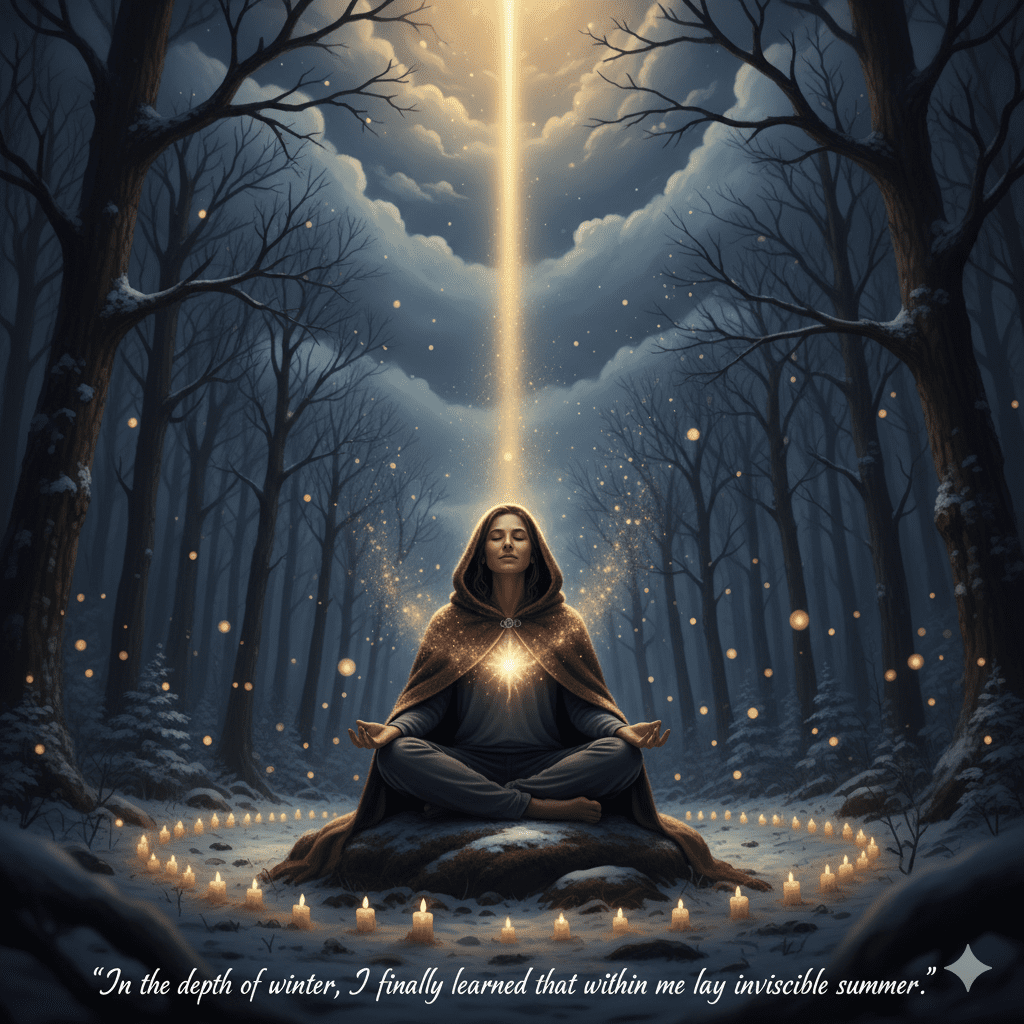
“In the depth of winter, I finally learned that within me lay an invincible summer.”
This season, try not to just endure the dark. Embrace it. Light a candle, wrap yourself in warmth, allow yourself to rest without guilt, and know that the light is already on its way back to you.