
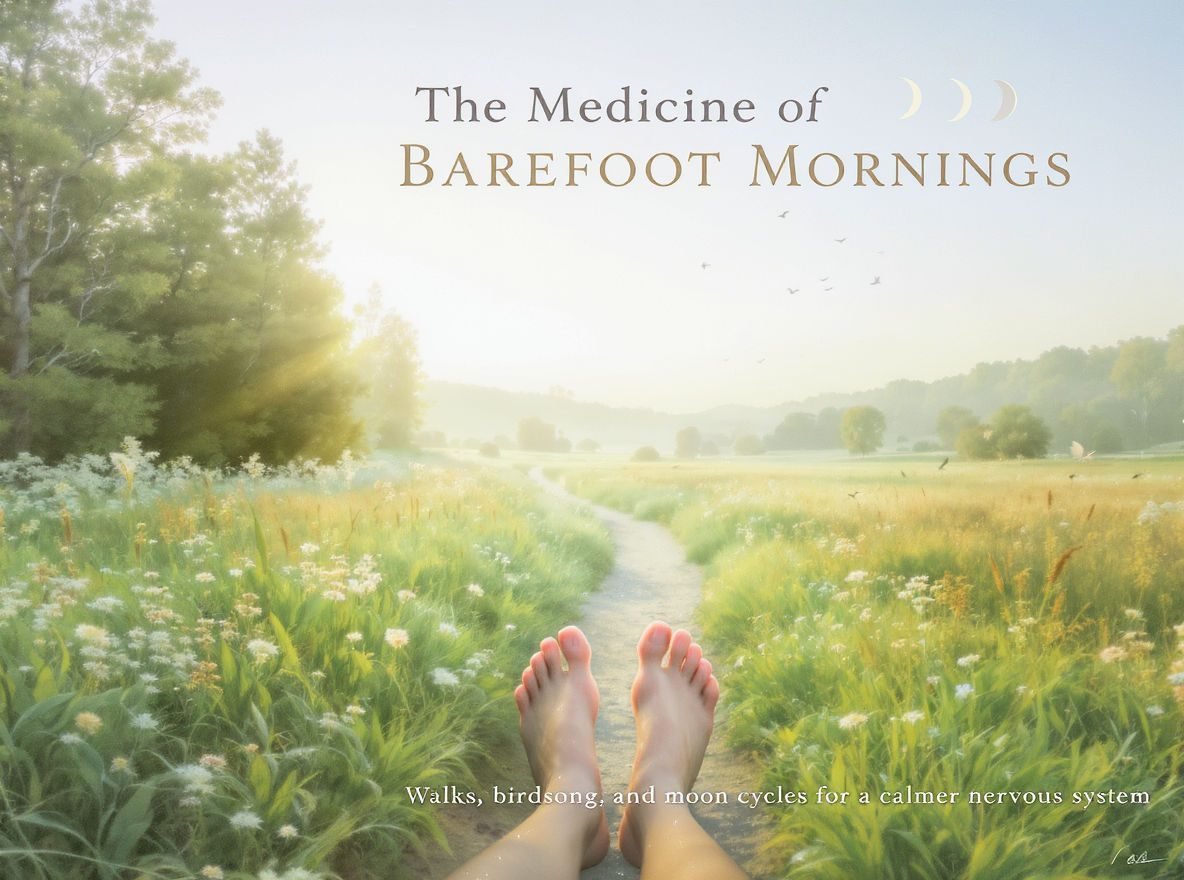
How walks, birdsong, and moon cycles soothe the modern nervous system
“When life becomes too loud, do not only search for silence in the mind; let the feet touch earth, let the ears return to birds, let the eyes remember the moon.” — Aroonji
Modern life asks much of us.
It asks us to wake to alarms instead of dawn, to stare into rectangles instead of horizons, to measure our days by deadlines rather than sunlight. In offices, classrooms, banks, clinics, and glowing IT corridors, the mind is constantly called forward, forward, forward. Yet the body is older than the calendar invite. The heart is older than the screen.
And so stress grows—not only because we have too much to do, but because we have too little sky, too little stillness, too little contact with the living world that once held human beings in rhythm.
Many people think peace must be found through a perfect solution, a better app, a stronger will. But often peace begins in something much simpler: a walk without hurry, bare feet on safe grass, the sound of birds in the morning, and a quiet glance at the moon before sleep.
Mary Oliver once asked, “Tell me, what is it you plan to do / with your one wild and precious life?” It is a beautiful question, because it reminds us that life is not meant only to be managed. It is meant to be felt.
Walking as a return, not a task
Walking is one of the oldest human medicines. But I do not mean walking as performance—counting steps, burning calories, multitasking with headphones and messages. I mean walking as return.
A true walk is not a march toward productivity. It is a gentle reintroduction to being alive.
When you walk slowly enough, your breathing changes. Your gaze softens. The mind, which was packed tightly like a crowded suitcase, begins to unpack itself. Trees do not rush you. Grass does not interrupt you. A path asks for nothing except your presence.
This is why even ten or fifteen minutes in nature can feel like opening a window in a room that has been closed too long. The problems may still exist, but the nervous system meets them differently. The forest may not answer your emails, but it changes the one who will.
The wisdom of bare feet
There is something deeply humbling about walking barefoot on the earth where it is clean and safe. The soles of the feet are like forgotten doors. The moment they meet cool soil, morning dew, warm stone, or soft grass, a different conversation begins.
Modern stress often lives in the head. Barefoot contact brings awareness down into the body. It reminds us that we are not floating brains with inboxes. We are creatures of bone, breath, skin, and seasons.
To stand barefoot on the earth is to remember that support is not always psychological. Sometimes it is literal. Sometimes healing begins with simply feeling that you are held.
I often tell my students this:
the mind under stress is like a bird trapped in a room; the body in nature opens a window.
Birdsong and the language of safety
Before the world speaks to us through news, traffic, and notifications, nature speaks through birds.
Birdsong is not just background decoration. It is one of the softest ways life says, “Morning has arrived. You may begin again.”
If you sit quietly during a walk and listen—not casually, but truly listen—you will notice something tender happening inside. The chest loosens. The forehead softens. Attention becomes less sharp and more spacious. One bird answers another, and without trying, you begin to feel part of a world that is still singing.
Walt Whitman wrote, “I believe a leaf of grass is no less than the journey-work of the stars.” What a magnificent reminder. The ordinary world is not ordinary at all. A bird on a branch, a breeze through leaves, a patch of moss beside your shoe—these are not interruptions from life. They are life.
The moon and the forgotten rhythm of time
Then there is the moon, that ancient lamp above human worry.
Modern time is mechanical. It is chopped into appointments, targets, and reminders. But moon time is living time. It waxes, it wanes, it disappears, it returns. It teaches us that not every phase must be full, bright, or productive.
The new moon whispers of rest, emptiness, and quiet beginnings.
The full moon speaks of illumination, fullness, and release.
The waning moon reminds us to let go.
The waxing moon invites us to grow again.
When you begin to notice the moon—even for a few moments each evening—you step out of the hard clock of modern stress and back into a softer cosmic rhythm. You remember that life moves in cycles, not straight lines. There are times to bloom, and times to become seed again.
This alone can be deeply healing for a tired heart.
A small ritual for modern people
You do not need to move to a mountain or abandon your responsibilities. This path is gentle and practical. It can live inside an ordinary life.
Try this for one week:
In the morning, before checking your phone, step outside for a short walk.
If the ground is safe, stand barefoot on the grass for two or three minutes.
Pause and listen until you can notice at least three different natural sounds.
In the evening, look up at the moon, or even the dark sky if the moon is hidden, and let the day leave your body with one long exhale.
That is all. Small acts, done with sincerity, can become a doorway.
Because nature does not demand that you become someone else. It simply invites you back to yourself.
Not escape, but remembrance
To reconnect with nature is not to run away from modern life. It is to stop living as though you were separate from life itself.
We were not designed only for speed, noise, and fluorescent rooms. We were shaped also by rivers, birds, moonlight, wind, and the slow intelligence of the earth. When these are missing, something inside us becomes brittle. When they return, something ancient begins to drink again.
So walk.
Walk without rushing.
Let your feet learn humility from the soil.
Let birdsong comb the knots from your mind.
Let the moon remind you that you do not have to be full every night.
Perhaps peace is not so far away.
Perhaps it is already waiting at the edge of the path, barefoot and listening.
What might change in your life if, for the next seven days, you let the earth, the birds, and the moon help shape your inner world?
Ready to go deeper…?
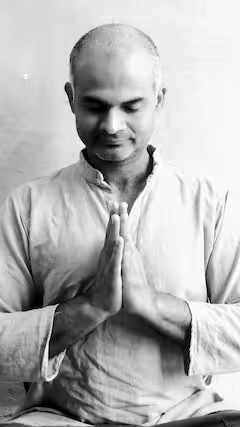
To learn and experience the wisdom of the Vedas with Aroonji.
an experienced yoga teacher, Ayurveda expert, life coach and spiritual guide, born and raised in India, with experience working across three continents—you are warmly invited to join private sessions for groups or individuals, or existing group sessions at YogaSole, Fiesole.
Contact via WhatsApp at +39-3510278911 or email yogafiesole@gmail.com / aroonjilifecoach@gmail.com