
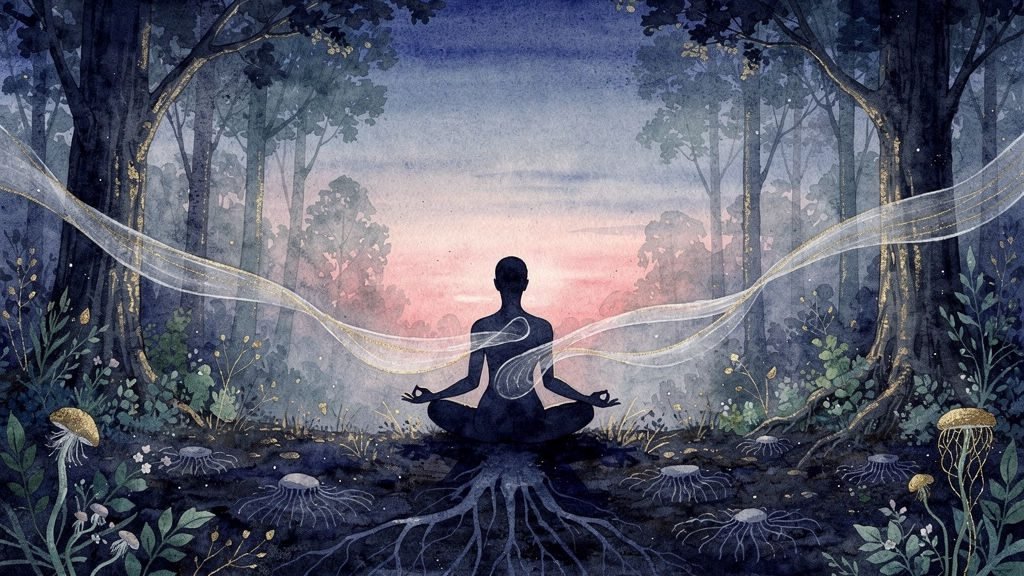
A two-part reflection on history, healing, and the future of inner exploration
“When a substance is used for amusement, it scatters the mind. When it is approached with reverence, it can become a lamp in the cave.” — Aroonji
There is a great difference between escaping yourself and meeting yourself.
This is where the conversation around psychedelics so often loses its soul. For many, these substances have been painted either as dangerous poison or glittering entertainment. Yet across human history, they were rarely approached as toys. In many cultures, they were treated more like keys—keys to mystery, grief, initiation, healing, and communion with something greater than the ordinary mind.
To speak honestly, psychedelics are not inherently spiritual. They do not make a person wise. They do not do the inner work for you. But in the right setting, with maturity, discernment, preparation, and integration, they can sometimes loosen the rusted hinges of the psyche and allow a person to see what has been hidden behind the locked door.
I know this terrain from two sides. In my twenties, I explored these worlds myself with youthful hunger. I learned that altered states can reveal beauty, but also illusion. Today, my relationship to these medicines is very different. There is less appetite for thrill, and more respect for truth.
My work is centered not on intoxication, but on transformation: breathwork, movement, meditation, and the etheric yoga practices I have developed to help people move energy, meet emotion, and integrate what arises. Where lawful, ethically appropriate, and carefully screened, psychedelic work may sometimes be part of that container—but always as one instrument in a larger symphony of healing, never as a shortcut, and never as spectacle.
Part I — From Sacred Rite to Social Fear
“If the doors of perception were cleansed, everything would appear to man as it is, infinite.” — William Blake
Before psychedelics were criminalized, sensationalized, and folded into modern culture wars, many of them lived inside ritual.
Among the Mazatec people of Oaxaca, psilocybin mushrooms were used in veladas—ceremonial night vigils for healing and vision. In Amazonian traditions, ayahuasca was held within ceremonial frameworks for divination, purification, and spiritual diagnosis. Peyote has long been used in Indigenous North American traditions, including within what became the Native American Church, as a sacrament rather than a party drug. In Central Africa, iboga found ritual use within Bwiti initiation. Even in ancient Greece, scholars have long debated whether the kykeon of the Eleusinian Mysteries may have involved psychoactive elements, though the evidence remains interpretive rather than definitive (Ruck et al., 1978). And in Vedic literature, the mysterious Soma still stands as one of history’s great unresolved questions: a sacred entheogenic sacrament, a divine metaphor, a plant now lost to memory—or all of these at once.
What matters most is not whether every ancient reference maps neatly onto a modern pharmacological category. What matters is that many cultures understood a truth modernity forgot: there are states of consciousness in which the human being can encounter death, grief, divinity, shadow, awe, and belonging in ways that ordinary language struggles to contain.
These were not always “self-improvement” practices in the modern Western sense. They were often about initiation, cosmology, healing, ancestry, and direct participation in the sacred. The goal was not to become more productive. The goal was to become more whole.
So how did these sacramental tools become taboo?
Part of the answer lies in colonial history. Indigenous ceremonial systems were often suppressed by missionaries and imperial governments, who saw them as primitive, threatening, or incompatible with conversion. Ritual plants became entangled with efforts to erase whole worlds of knowledge.
Then came the 20th century. In the 1950s and early 1960s, psychedelics were not only countercultural curiosities; they were serious subjects of psychiatric research. LSD, in particular, was widely studied for alcoholism, end-of-life distress, and psychotherapy. But by the late 1960s, these substances had become fused in the public imagination with youth rebellion, anti-war protest, social upheaval, and media panic. Scientific nuance drowned in political noise.
The United States Controlled Substances Act of 1970 placed LSD and psilocybin into Schedule I, designating them as having high abuse potential and no accepted medical use under federal law. The 1971 U.N. Convention on Psychotropic Substances reinforced prohibition globally. Research became difficult, funding dried up, and an entire field entered a long winter.
To be fair, not all caution was irrational. Psychedelics are powerful. They can destabilize vulnerable people. They can unearth trauma faster than someone can metabolize it. They are not suitable for everyone, especially those with certain psychiatric risks, including a personal or family history of psychotic disorders or some forms of bipolar disorder. But prohibition did not simply regulate risk. It also flattened complexity. It treated sacred use, clinical inquiry, reckless use, and Indigenous sacrament as though they were all the same thing.
And this is often what fear does: it makes everything wear the same mask.
Part II — The Return of the Medicine
“The art of spiritual growth has to do with how quickly you recognize attachments and how quickly you can release them.”
― Ram Dass, Polishing the Mirror: How to Live from Your Spiritual Heart
In recent decades, that long winter has begun to thaw.
The psychedelic resurgence did not begin with trendiness. It began with patient researchers, careful protocols, and a willingness to reopen questions that had been politically buried. Universities such as Johns Hopkins, Imperial College London, NYU, and others helped bring psychedelic research back into serious conversation.
Some of the results have been striking.
Early modern studies found that psilocybin, when given in supportive conditions, could occasion experiences participants ranked among the most meaningful of their lives (Griffiths et al., 2006, Psychopharmacology). Later research suggested significant reductions in depression and anxiety among patients facing life-threatening cancer diagnoses after psilocybin-assisted therapy (Griffiths et al., 2016, Journal of Psychopharmacology; Ross et al., 2016, Journal of Psychopharmacology). Trials at Imperial and elsewhere suggested psilocybin-assisted therapy may help some people with treatment-resistant depression, though results have varied across study designs and follow-up periods (Carhart-Harris et al., 2016, The Lancet Psychiatry; Carhart-Harris et al., 2021, New England Journal of Medicine). A randomized clinical trial in major depressive disorder found large short-term reductions in depressive symptoms after psilocybin-assisted therapy, though the sample was modest and further replication remains important (Davis et al., 2020, JAMA Psychiatry). A large phase 2b trial also found that a 25 mg dose of synthetic psilocybin, paired with psychological support, produced meaningful improvements for some treatment-resistant depression patients, while also showing that benefits are neither universal nor simple (Goodwin et al., 2022, New England Journal of Medicine).
LSD, too, has quietly returned to careful study. A small Swiss pilot trial suggested LSD-assisted psychotherapy may reduce anxiety associated with life-threatening illness in some patients (Gasser et al., 2014, Journal of Nervous and Mental Disease). The evidence base for LSD therapy is still smaller than for psilocybin in the modern era, but the old conversation is no longer closed.
What do these studies really tell us?
Not that psychedelics are miracle cures.
Not that everyone should use them.
Not that one grand mystical night replaces years of therapy, discipline, or spiritual practice.
They suggest something subtler and more profound: under certain carefully held conditions, these compounds may help soften rigid patterns of thought, increase emotional openness, evoke psychologically meaningful experiences, and allow people to revisit pain without being entirely imprisoned by it.
In yogic language, you might say they can briefly thin the veil of habitual mind. In therapeutic language, you might say they can interrupt maladaptive loops. In poetic language, they can make the walls of the inner house transparent for a moment, so you can finally see the room you have been living in.
But the real work is not the opening. The real work is what follows.
A person may glimpse forgiveness in a ceremony and still go home unable to speak honestly with their partner. They may feel cosmic unity one evening and still carry the same old reflexes by Monday morning. Vision is grace; embodiment is labor.
This is why preparation and integration matter more than the romance of the peak experience.
In my own path, what became clear over time was that the deepest transformation does not come from chasing extraordinary states. It comes from learning how to let revelation descend into the body. Breathwork helps regulate and open the nervous system. Movement helps unfreeze what has been held. Stillness helps one listen. Etheric yoga, as I teach it, helps people sense the subtle architecture beneath thought—the currents, knots, and forgotten rivers of energy that shape feeling long before feeling becomes speech.
Where altered-state work is approached lawfully and with careful screening, the medicine is not the center. The person is the center. The intention is the center. The safety of the container is the center. The ethical integrity of the guide is the center. And the integration afterward—how one lives, loves, grieves, forgives, and changes—is the true measure of whether anything sacred happened at all.
Why the taboo is fading
“Tell me, what is it you plan to do / with your one wild and precious life?” — Mary Oliver
The taboo around psychedelics is beginning to loosen for a few reasons.
First, modern mental health systems are strained, and many people feel failed by purely symptom-management approaches. Second, the data—while still evolving—has become too significant to dismiss outright. Third, a younger generation is asking deeper questions about consciousness, trauma, spirituality, and meaning. And fourth, Indigenous knowledge has continued to survive despite centuries of suppression, reminding the modern world that altered states are not a novelty but part of a much older human story.
Still, we should be wary of replacing one distortion with another.
The old distortion said: these substances are only dangerous.
The new distortion says: these substances are salvation.
Neither is true.
Psychedelics can illuminate. They can also confuse. They can humble the ego. They can also secretly inflate it. Some people emerge softer and more truthful. Others become attached to grand narratives, spiritual bypassing, or endless seeking. The mind is clever; it can even turn awakening into vanity.
The future of psychedelics
“as soon as you give it all up you can have it all”
― Ram Dass, Be Here Now
The future, I believe, will depend on whether we treat psychedelics as commodities or as responsibilities.
A mature future will require strong screening, trauma-informed care, ethical training, respect for Indigenous lineages, transparent regulation, and a deep emphasis on integration. It will also require room for non-drug pathways—breath, meditation, yoga, fasting, prayer, silence, music, devotion, and embodied practice. Otherwise, we risk teaching people to knock on mystical doors without ever learning how to live in the house.
The wisest future is not one in which everyone takes psychedelics. It is one in which human beings become more skillful at transformation itself.
Some will find that transformation through therapy.
Some through devotion.
Some through asana and pranayama.
Some through grief honestly endured.
Some through a carefully held altered-state experience that shows them, perhaps for the first time, that their life is not a punishment but a prayer waiting to be spoken correctly.
Psychedelics may have a place in that future. But only if we remember that the aim is not intensity. The aim is truth.
A note of care …
Psychedelic work is not appropriate for everyone, and it should never be romanticized. Certain mental health histories, medication interactions, cardiovascular concerns, unstable life circumstances, and poorly held settings can increase risk. Legal status also varies widely across countries and regions. Any serious conversation about these substances must include discernment, ethics, and safety—not just fascination.
Because in the end, the question is not, “How far can I go?”
The better question is, “What am I truly ready to meet?”
Sometimes the medicine is a mushroom. Sometimes it is a breath. Sometimes it is the moment you stop running from your own soul.
What door in your life is waiting not to be kicked open—but to be opened with reverence?
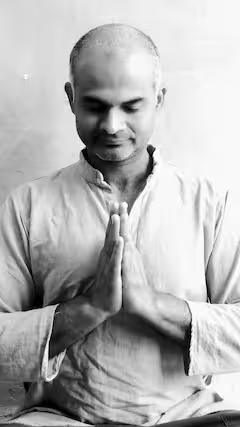
To learn and experience the wisdom of the Vedas with Aroonji—an experienced yoga teacher, Ayurveda expert, life coach, and spiritual guide, born and raised in India, with experience working across three continents—you can book private sessions for groups or individuals, or join existing group sessions at YogaSole, Fiesole.
Contact via WhatsApp: +39-3510278911 or email: yogafiesole@gmail.com.
Aroonji
Notes & references
Griffiths, R. R. et al. (2006). Psilocybin can occasion mystical-type experiences having substantial and sustained personal meaning and spiritual significance. Psychopharmacology.
Griffiths, R. R. et al. (2016). Psilocybin produces substantial and sustained decreases in depression and anxiety in patients with life-threatening cancer. Journal of Psychopharmacology.
Ross, S. et al. (2016). Rapid and sustained symptom reduction following psilocybin treatment for anxiety and depression in patients with life-threatening cancer. Journal of Psychopharmacology.
Carhart-Harris, R. L. et al. (2016). Psilocybin with psychological support for treatment-resistant depression: an open-label feasibility study. The Lancet Psychiatry.
Carhart-Harris, R. L. et al. (2021). Trial of psilocybin versus escitalopram for depression. New England Journal of Medicine.
Davis, A. K. et al. (2020). Effects of psilocybin-assisted therapy on major depressive disorder. JAMA Psychiatry.
Goodwin, G. M. et al. (2022). Single-dose psilocybin for a treatment-resistant episode of major depression. New England Journal of Medicine.
Gasser, P. et al. (2014). Safety and efficacy of LSD-assisted psychotherapy for anxiety associated with life-threatening diseases. Journal of Nervous and Mental Disease.
Controlled Substances Act (United States, 1970).
Convention on Psychotropic Substances (United Nations, 1971).